How many calories do you need per day?
Daily energy needs depend on three things: how much energy your body uses at rest, how much you move and what your goal is. The calculator works them out in this order:
- Basal metabolic rate (BMR): the energy your body uses at complete rest, for breathing, heartbeat and keeping warm.
- Maintenance calories (TDEE): BMR multiplied by an activity factor. That is how many calories keep your weight the same.
- Daily target: maintenance calories plus or minus the adjustment you choose, for example −500 kcal to lose weight.
The Mifflin-St Jeor equation
Mifflin-St Jeor is the most widely recommended equation for estimating BMR in healthy adults. It uses weight, height, age and sex:
Men:   BMR = 10 × weight (kg) + 6.25 × height (cm) − 5 × age + 5
Women: BMR = 10 × weight (kg) + 6.25 × height (cm) − 5 × age − 161
Worked example
A man, 36 years old, 182 cm, 92 kg, training 1–3 times a week, who wants to lose weight:
| Step | Calculation | Result |
|---|---|---|
| BMR | 10 × 92 + 6.25 × 182 − 5 × 36 + 5 | 1,882 kcal |
| TDEE | 1,882.5 × 1.375 | 2,588 kcal |
| Daily target | 2,588 − 500 | 2,088 kcal |
| Protein (30%) | 2,088 × 0.30 ÷ 4 | 157 g |
| Fat (30%) | 2,088 × 0.30 ÷ 9 | 70 g |
| Carbs (the rest) | 2,088 × 0.40 ÷ 4 | 209 g |
The calculator above starts with exactly this example. Change any value and the result updates straight away.
Choosing your activity level
The activity factor covers both training and everyday movement. If you are torn between two levels, pick the lower one: people overestimate their activity more often than they underestimate it.
| Activity level | Factor |
|---|---|
| Basal metabolic rate only (no movement) | 1.0 |
| Little or no exercise, desk job | 1.2 |
| Exercise 1–3 times per week | 1.375 |
| Exercise 4–5 times per week | 1.465 |
| Daily exercise or intense exercise 3–4 times per week | 1.55 |
| Intense exercise 6–7 times per week | 1.725 |
| Very intense daily exercise or a physical job | 1.9 |
Calorie deficit and surplus
The adjustment is the difference between maintenance calories and your daily target:
- Weight loss: usually −300 to −600 kcal per day. A kilogram of body fat is about 7,700 kcal, so a 500 kcal daily deficit in theory gives about half a kilogram per week.
- Maintenance: an adjustment of 0.
- Muscle gain: usually +200 to +400 kcal per day, with strength training and enough protein.
How macros are calculated
The calculator splits the daily target by the percentages you set. Protein and fat come from their percentages and carbs take the remaining calories:
- protein and carbs have 4 kcal per gram,
- fat has 9 kcal per gram.
Next to the result you also see protein per kilogram of body weight. For most adults who train, recommendations range from about 1.6 to 2.2 g per kilogram; lower for people who don’t train. If the number is too high or too low, change the protein percentage.
For nutritionists: save the result as a client target
In FitMeni the same calculation runs on data you already have about a client: the latest measurement, age, sex and activity level. You check the result, adjust it if needed and save it as a nutrition target, and while you build a meal plan FitMeni shows how far the plan is from the target.
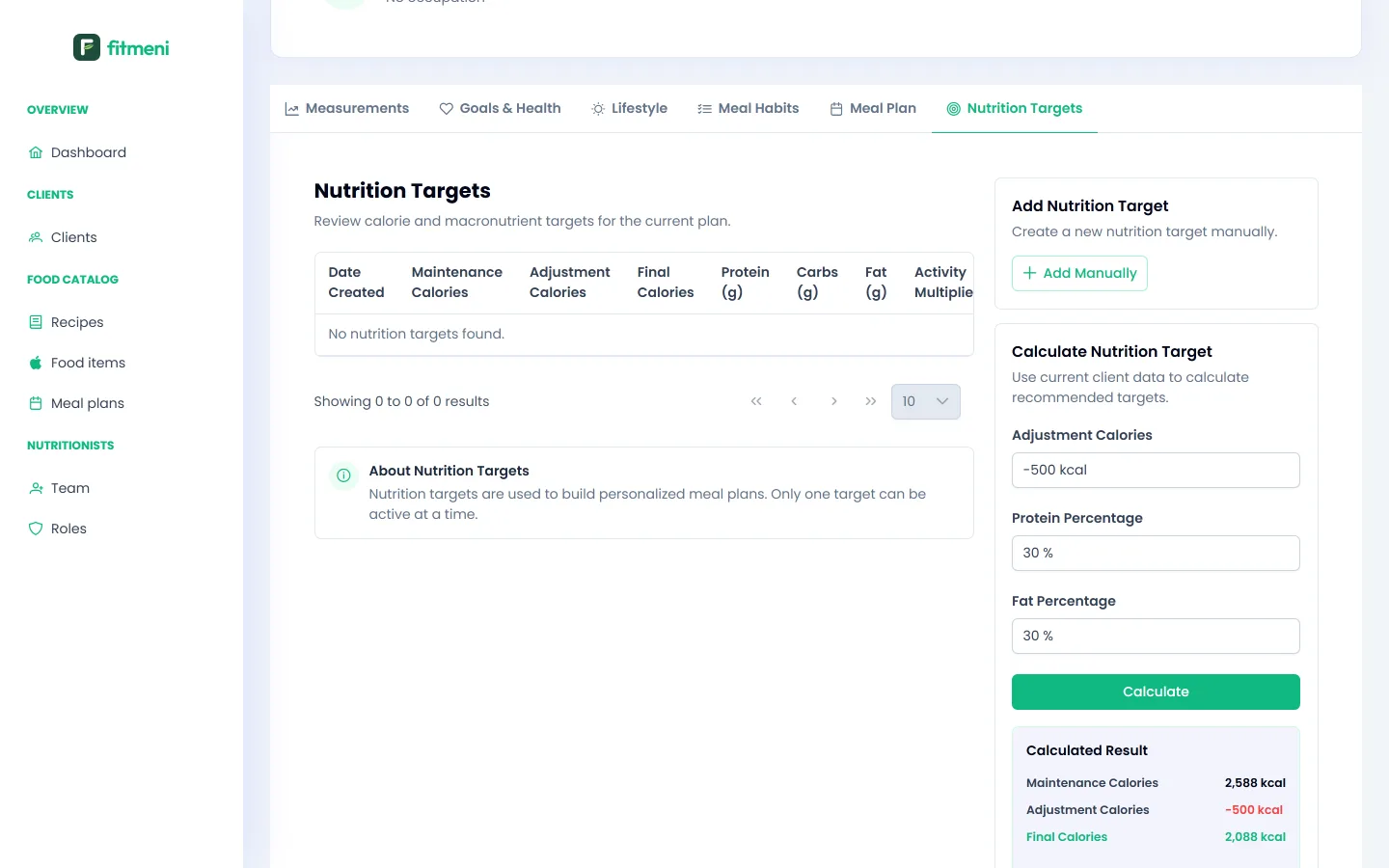
See the step-by-step guide Nutrition targets. The app is free.